

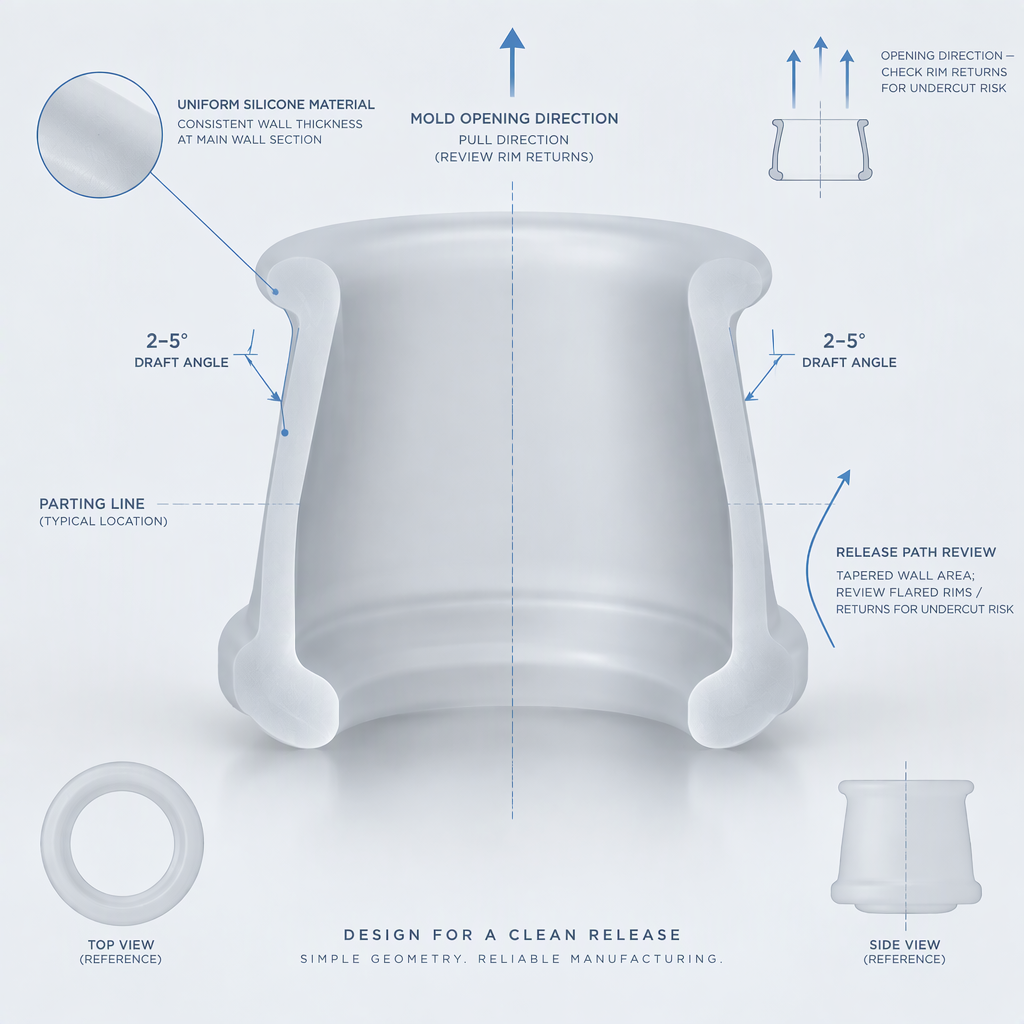
Start with draft as a release requirement, not a cosmetic afterthought
Draft is the intentional taper on faces that run parallel to the mold-opening direction, and its practical job is to help the molded silicone part release with less scraping, drag, or surface damage.
LSR design guidance gives contextual examples such as 0.5° on some vertical faces, 2° for many situations, 3° for shutoff or light texture, and 5° or more for medium texture; the same guidance also notes that some shallow LSR parts may tolerate very low or zero draft when mold construction permits.
Those numbers are not a universal rule for every silicone mold design draft because the needed taper changes with wall depth, wall thickness, material behavior, ejection approach, shrink, finish, texture, and the manufacturing process available.
Match draft to the features that raise demolding risk
The more a feature increases drag against the mold, the more carefully its draft, finish, parting line, and release direction should be reviewed before a quote becomes a tool order.
| Design input | Why it affects release | Buyer action before RFQ |
|---|---|---|
| Wall depth and vertical face height | Deeper faces stay in contact with the mold longer during release, so the draft decision becomes more important. | Flag tall cosmetic walls, sleeves, bottle bodies, cases, and vertical ribs in the CAD review. |
| Surface finish or texture | Texture can behave like many small undercuts, increasing release resistance and the amount of draft needed. | Send texture targets, gloss expectations, and any grip pattern drawings with the quote package. |
| Material and process limits | Required draft depends partly on material behavior, shrink, ejection method, and manufacturing capability. | Ask the molder to review the chosen silicone hardness, molding process, and intended release direction together. |
| Shutoff areas | LSR guidance treats shutoff and textured areas as cases that may need more draft than a simple smooth wall. | Mark shutoffs, sealing lands, slot openings, and thin lips so the toolmaker can check wear and release risk. |
Treat texture and undercuts as release-risk multipliers
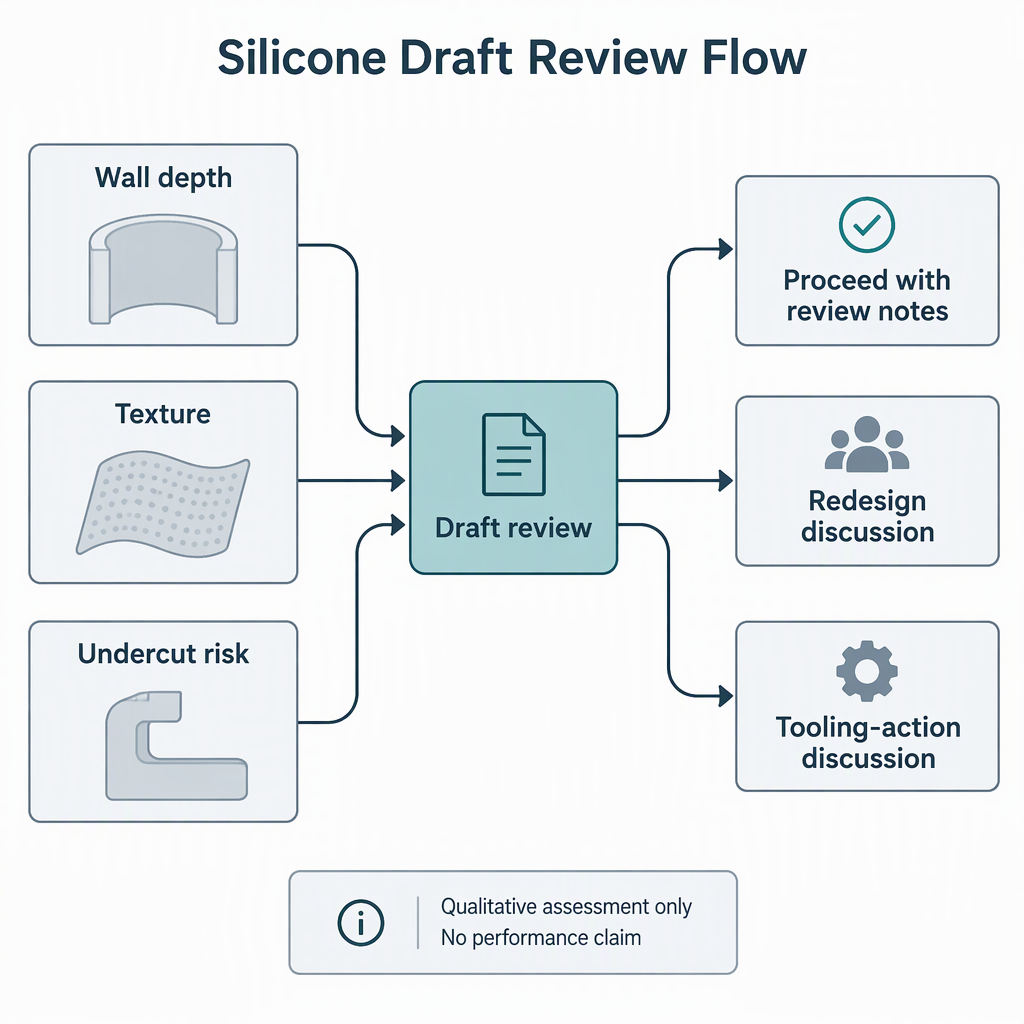
Texture, logos, grip features, holes, hooks, and undercuts should be reviewed as release-risk multipliers because they can increase drag or lock the part into the mold.
| Feature scenario | Release risk | Practical draft decision |
|---|---|---|
| Smooth vertical wall | Release depends mainly on wall depth, material behavior, shrink, and ejection conditions. | Use the molder's draft baseline, then adjust for height and cosmetic requirements. |
| Light texture or matte surface | Texture can create micro-undercuts, so more draft may be needed than on a polished wall. | Confirm texture depth and direction before the mold design is frozen. |
| Functional undercut | An undercut projects back into the main body of the part and can make demolding difficult or impossible when it is too deep. | Decide whether the feature can be softened, moved to the parting line, split, or handled with a more complex mold action. |
| Deep snap, hook, or return lip | If an undercut is essential, a more complex mold action may be possible, but it can add tooling complexity and cost. | Ask for a tooling review instead of assuming flexible silicone can always be pulled free cleanly. |
Keep quality and compliance files separate from draft rules
Quality and compliance files help define the product approval path, but they do not replace a mold-release review for draft, texture, undercuts, and parting-line design.
For food-contact context, the German Federal Institute for Risk Assessment explains that its BfR Recommendations on Food Contact Materials are regularly adjusted, are not legally binding standards, and describe the current state of science and technology for certain food-contact materials under stated conditions.
The official BfR recommendations database lists Recommendation XV for silicones and also lists rubber-related categories for food-contact materials.
- For kitchen, baby, drinking, or food-contact silicone products, identify which food-contact document family the product is expected to address before material selection and tooling review.
- Treat BfR food-contact recommendations as technical and regulatory context, not as automatic proof that a specific supplier or product is certified.
- Mitour Silicone presents itself as an English-facing custom silicone OEM/ODM manufacturer for categories such as collapsible water bottles, baby and infant products, promotional gifts, kitchen silicone, beauty and cosmetic accessories, and pet products.
- Ask the supplier to provide the product-specific test reports, declarations, material grades, and quality documents that your market, retailer, or importer requires.
Build the RFQ around the data that controls clean release
A strong silicone RFQ should show the geometry, finish, release-sensitive surfaces, and documentation requirements that control draft decisions, not only the outer size and target price.
- Send 3D CAD and 2D drawings that identify the intended mold-opening direction and any surfaces that run parallel to that direction.
- Mark cosmetic surfaces, sealing surfaces, grip textures, logos, and areas where scraping or drag marks would be unacceptable.
- Ask the molder to confirm the draft approach for smooth walls, shutoffs, light texture, and heavier texture rather than applying one angle to the whole part.
- Call out undercuts, holes, returns, snap features, and deep lips so the toolmaker can advise whether redesign or additional mold action is needed.
- Share silicone hardness targets, finish requirements, wall-depth concerns, and expected ejection or demolding constraints so the supplier can connect material and tooling decisions.
- For food-contact or regulated consumer goods, include the required documentation route, market, and buyer test expectations with the moldability review.
Separate general design guidance from supplier capability claims
Use supplier pages to understand service scope, then ask for project-specific proof before relying on certifications, capacity, lead time, customer results, or performance claims.
Conclusion
The best draft strategy is the one that matches the release risk of the actual silicone part, surface finish, material choice, and mold construction, then gets confirmed before tooling.
For clean mold release, begin with draft as a manufacturability requirement, increase scrutiny around texture and undercuts, and keep quality files from being confused with mold-design proof.
- Draft reduces drag on mold-opening faces and should be reviewed early.
- LSR draft examples are useful starting points, but they must be confirmed against the actual geometry and process.
- Undercuts deserve a tooling discussion, not a default assumption that silicone flexibility will solve release.
FAQs
These buyer questions help turn a general silicone mold design draft discussion into a practical tooling review.
Can this article promise a universal best draft angle for every silicone product?
No. Draft depends on wall depth, wall thickness, material behavior, ejection, shrink, finish, texture, and manufacturing capability, so the final angle should be confirmed for the actual part.
Why can some silicone parts use less draft than rigid plastic parts?
Some LSR guidance allows draft rules to be stretched for shallow parts when mold construction permits, but that does not remove the need to review release risk, finish, and tooling details.
Does a textured silicone grip need more draft?
Often it should be reviewed for more draft because texture can create micro-undercuts and increase resistance during release.
Should undercuts always be avoided in silicone parts?
Not always, but deeper undercuts can make removal difficult or impossible, and essential undercuts may require redesign or more complex mold action.
Do food-contact documents decide the mold draft?
No. Food-contact documents help frame material and compliance expectations, while draft is a moldability decision based on part geometry, surface finish, and release conditions.
What should a buyer send before asking for a silicone mold quote?
Send CAD, drawings, release direction, surface finish, texture details, cosmetic and sealing surfaces, material targets, and any documentation requirements that affect design review.
Can supplier service categories prove a part will release cleanly?
No. Service categories can show whether a supplier works in relevant silicone product areas, but clean release still requires a part-specific DFM and tooling review.


