

Allowing for silicone mold shrinkage is not a one-number exercise: confirm the exact silicone grade, molding route, cavity and part geometry, process conditions, post-cure expectations, tolerance targets, and first-article measurement plan before the mold is cut.

What silicone mold shrinkage means for product developers
In practical mold design, silicone mold shrinkage means the cavity must be planned around the final measured part, because liquid silicone rubber is injected into a closed mold and cured into a solid part under heat and pressure.
Dow describes liquid silicone rubber as a two-part dispensable silicone material that is mixed and rapidly heat-cured into durable elastomers, with liquid injection molding among the appropriate fabrication methods; see Dow’s liquid silicone rubber overview.
Wacker describes LSR grades as two-part silicone rubbers processed by injection molding and vulcanized under heat and pressure, and also connects injection molding with complex part geometries and precise dimensions.
For consumer-product teams, the useful takeaway is that the drawing dimension, the cavity dimension, and the measured molded dimension should be treated as related but not identical values during tooling review.
Why one shrinkage rate is risky
A single shrinkage rate is risky because silicone part dimensions are influenced by material selection, heat curing, molding pressure, geometry, and any post-curing plan rather than by material family name alone.
Momentive describes LSR as a two-component silicone elastomer that can be molded quickly at elevated temperature and notes that post-curing may be used to optimize physical properties and reduce volatile or cyclic siloxane content for relevant industry or regulatory needs.
Because heat and pressure are part of the LSR molding process, a buyer should not approve a cavity oversize assumption until the supplier has tied it to the grade, process window, dimensional targets, and validation plan.
| Buyer assumption | Why it can fail | Better RFQ question |
|---|---|---|
| “Any LSR grade will shrink the same way.” | LSR materials are two-part systems selected and fabricated for particular applications. | Which exact grade and supplier data will be used for the shrinkage allowance? |
| “The molding process will not affect dimensions.” | LSR molding uses heat and pressure, and the process is part of achieving precise dimensions. | Which molding conditions are assumed when the cavity dimensions are proposed? |
| “Post-cure is only a finishing detail.” | Post-curing can be part of meeting property or volatile-content expectations. | Will post-cure be required, and will dimensions be checked before and after it? |
Inputs to confirm before mold cutting
Before mold cutting, confirm the material grade, part drawing revision, critical dimensions, application environment, molding process, post-cure plan, tolerance strategy, and first-article approval method.
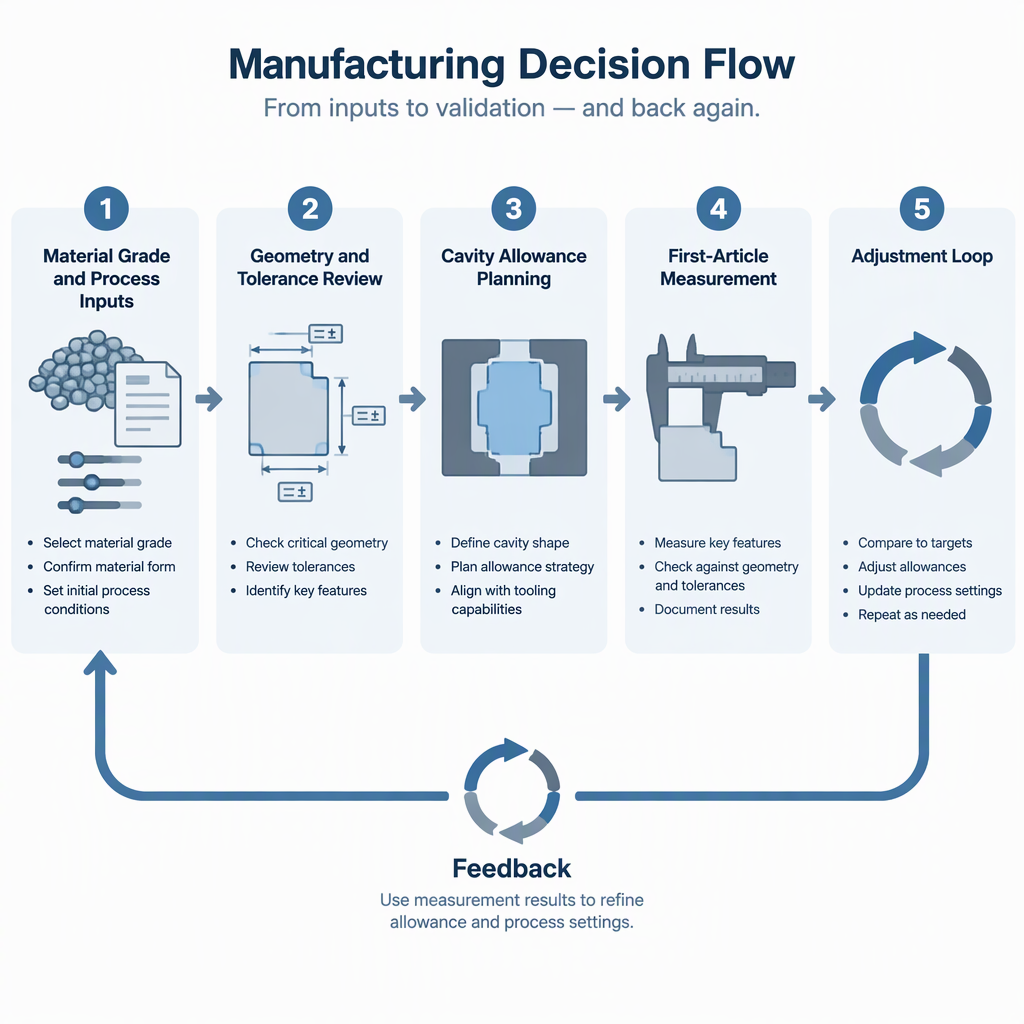
- Name the exact silicone material family and grade instead of requesting a generic “silicone” cavity allowance.
- Identify whether the project uses liquid silicone rubber injection molding, because LSR is injected into a closed mold and cured into the final part.
- State the application category, such as consumer goods, infant care, healthcare-related parts, electronics, or another sector, so the supplier can screen use conditions and documentation needs.
- Clarify whether post-curing is expected for property optimization or volatile-content control.
- Mark critical dimensions, wall sections, ribs, fillets, undercuts, and ejection-sensitive features on the drawing before tooling assumptions are frozen.
| Input | What to confirm | Why it matters |
|---|---|---|
| Material data | Two-part LSR material grade and supplier guidance | Material behavior is the starting point for the cavity allowance. |
| Process route | Injection molding assumptions, heat, pressure, and automation expectations | Process conditions influence dimensional repeatability. |
| Part geometry | Draft, wall thickness, ribs, fillets, and undercuts | Geometry affects moldability, ejection, and measurement risk. |
| After-molding steps | Post-cure and dimensional inspection timing | Dimensions should be evaluated at the point relevant to product release. |
Draft, venting and geometry decisions that affect shrinkage control
Shrinkage allowance should be reviewed with draft, venting, wall thickness, ribs, fillets, undercuts, and ejection because these features affect whether the part can be molded, released, and measured consistently.
- Start with the part drawing and highlight functional surfaces, sealing edges, assembly interfaces, and cosmetic zones that cannot drift beyond tolerance.
- Review draft and ejection together; LSR can sometimes tolerate low or zero draft on shallow parts when mold construction permits, but draft commonly helps moldability and part release.
- Check wall thickness, ribs, and fillets as a group, because abrupt section changes can create molding and dimensional-control challenges.
- Ask how gates and vents will be arranged so trapped air, fill balance, flash risk, and trim-sensitive edges are considered before steel is cut.
- Decide which dimensions will be measured on first articles and which noncritical surfaces can accept more variation.
Do not treat shrinkage allowance as a replacement for design-for-molding review. A cavity may be mathematically oversized, yet still produce unstable dimensions if the part geometry, release method, or measurement datum is poorly defined.
Tolerance and validation planning
When silicone shrinkage is uncertain, set tolerances by function and validation method, not by copying plastic-injection tolerances or applying a universal silicone percentage.
| Dimension type | Planning approach | Buyer check |
|---|---|---|
| Assembly interface | Review moldability, draft, and ejection before freezing the tolerance. | Ask for the proposed inspection datum and first-article measurement method. |
| Sealing or fit surface | Connect the tolerance to the process plan used to achieve precise dimensions. | Ask whether the supplier expects tool adjustment after first samples. |
| Cosmetic surface | Separate appearance criteria from functional dimensions. | Define acceptable flash, trim, and visual limits early. |
| Post-cure-sensitive feature | Confirm whether dimensions will be approved before or after post-cure. | Require the inspection report to state the conditioning stage. |
If the tolerance is tighter than the geometry and process can reasonably support, the result is usually repeated sampling, tool rework, or disputed acceptance criteria. Use the prototype and first-article stage to confirm the allowance before moving into production release.
Quality documents and application limits to verify
For silicone consumer products, quality planning should match the use category, contact conditions, material grade, post-cure plan, and the documents required by the buyer’s market.
- Confirm the product category and end use, because LSR is used across consumer goods, infant care, healthcare, electronics, and other sectors.
- Request material identification that matches the quoted grade rather than a generic silicone description.
- Ask whether post-curing is part of the process for the intended physical-property or volatile-content expectations.
- Ask how dimensional precision will be demonstrated for the selected molding process.
- For regulated or sensitive consumer uses, ask the supplier which current test reports, declarations, or material documents apply to the exact grade and finished-part condition.
A material supplier’s general LSR page is not the same as a finished-product compliance file. For sourcing, request project-specific documents tied to the material grade, colorant or additive package, manufacturing condition, and target market.
RFQ checklist for silicone mold shrinkage allowance
A strong RFQ gives the supplier enough information to justify the shrinkage allowance, propose the validation route, and identify mold-design risks before the tooling quote is approved.
- Attach the latest 2D drawing and 3D model, with the silicone grade or target material family clearly stated.
- Ask the supplier to state the molding route and process assumptions used for dimensional planning.
- Identify critical dimensions, draft-sensitive areas, wall-thickness transitions, ribs, fillets, and undercuts.
- State whether post-cure, conditioning, or volatile-content considerations apply to the finished part.
- Ask for a first-article inspection plan and the expected path for tool correction if measured dimensions miss target.
- Define the application and use conditions first, then select the material and molding route.
- Request grade-specific shrinkage guidance from the material and molding parties before approving cavity dimensions.
- Review mold-design features that can change ejection, flash, fill, or inspection results.
- Approve a sample-measurement plan before committing to production tooling release.
Application fit: when shrinkage planning matters most
Shrinkage planning matters most when a silicone part must assemble with other components, seal reliably, meet appearance limits, or support a market-specific quality file.
| Project situation | Why shrinkage planning matters | Best buyer action |
|---|---|---|
| Consumer goods or infant-care parts | Use conditions and documentation expectations can be more demanding than for simple promotional items. | Confirm material grade, post-cure plan, and finished-part documents. |
| Complex geometry with precise dimensions | Injection molding can support complex, precise parts, but the design must be matched to process assumptions. | Review critical dimensions and moldability before tool cutting. |
| Thin walls, ribs, fillets, or undercuts | These features can complicate release, fill, and dimensional consistency. | Request a design-for-molding review with the shrinkage proposal. |
| Parts requiring post-cure or volatile-content control | Post-cure can be part of meeting property or volatile-content expectations. | Define when dimensions will be measured and approved. |
Conclusion
The safest way to allow for silicone mold shrinkage is to convert uncertainty into a controlled tooling question: specify the material, process, geometry risks, tolerance priorities, post-cure plan, and first-article measurement route before approving the mold.
For OEM sourcing, ask suppliers to explain the proposed cavity allowance in relation to the actual LSR molding process and to define how samples will be measured, reviewed, and corrected if needed.
FAQs about silicone mold shrinkage
Most shrinkage questions can be answered by tying the part drawing to the material grade, molding process, geometry, post-cure plan, and inspection method.
Can I use one silicone mold shrinkage percentage for every project?
No. Use grade-specific and process-specific guidance because LSR materials and fabrication routes are selected for particular applications.
When should shrinkage be discussed with a supplier?
Discuss it before mold cutting, at the same time as draft, wall thickness, ribs, fillets, undercuts, ejection, and inspection planning.
Does post-curing affect dimensional approval?
It can affect the approval plan because post-curing may be used for physical-property or volatile-content expectations, so dimensions should be checked at the stage relevant to release.
Is LSR suitable for consumer-product applications?
LSR is used in consumer goods, infant care, healthcare, electronics, and other application areas, but the exact grade and documentation should match the intended use.
Should the mold be adjusted after first samples?
That depends on measured first-article results, the approved inspection method, and which dimensions are functional or cosmetic.
What should I ask for in a shrinkage-control RFQ?
Ask for the material grade, molding process assumptions, critical-dimension review, post-cure plan, first-article inspection method, and tool-adjustment approach.
Do draft and venting replace shrinkage allowance?
No. Draft, venting, ejection, and geometry review support moldability and dimensional consistency, while shrinkage allowance addresses the cavity-to-part size relationship.


