

Silicone mold venting helps reduce voids, bubbles and incomplete fill by giving trapped air a controlled escape path, but buyers should review it together with material delivery, flow path, vacuum function, temperature control, runner balance, part geometry and quality documentation before approving a mold or RFQ.
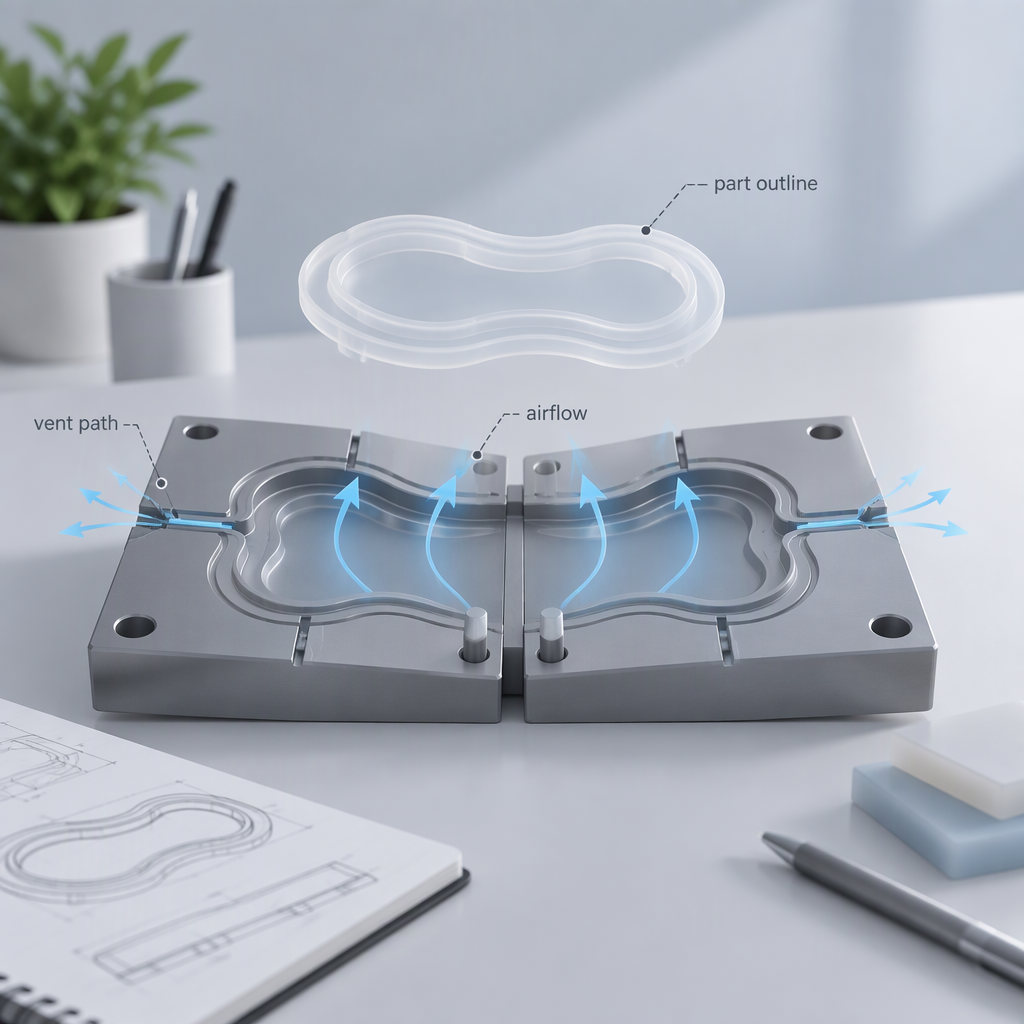
What mold venting does in silicone parts
Mold venting gives displaced air and gases a path out of the cavity while two-part liquid silicone rubber is metered, mixed and heat-cured into an elastomeric part.
For buyer conversations, it helps to start with the material system. Dow describes liquid silicone rubber as a two-part, dispensable silicone material used in liquid injection molding and related fabrication methods. In that setting, venting is not a cosmetic afterthought; it is part of how the cavity fills cleanly.
The same air-management principle appears outside injection molding as well: WACKER’s silicone processing tutorial describes vacuum deaeration of mixed two-part silicone for void-free potting applications, showing why trapped air control matters in silicone processing even when the exact mold design differs.
In molded consumer parts, poor evacuation can show up as bubbles, internal voids, unfilled edges, weak-looking last-fill zones or inconsistent surfaces. The right buyer question is therefore not only “Does the tool have vents?” but “How will the supplier confirm that the vent path, material flow and process window work together for this geometry?”
Why air gets trapped before a silicone part is fully filled
Air pockets occur when the advancing silicone front closes off an escape route before the cavity is fully packed or when process conditions add bubbles faster than they can be removed.
- Geometry creates last-fill areas. Thin ribs, deep pockets, lettering, undercuts and long flow paths can push air toward small terminal zones where escape becomes difficult.
- Runner and gate balance affect filling. If one area fills earlier than another, trapped air may remain in a delayed or isolated cavity zone.
- Vent condition matters. Blocked or ineffective vents reduce the available air path, so a defect can remain even when the mold appears to close normally.
- Air can enter before the mold fills. Silicone processing guidance on mixing and deaeration shows that trapped air may originate before the material reaches its final shape, so upstream material handling deserves review.
This is why a venting discussion should include part drawings, gate location, expected cosmetic surfaces and any recurring defect map. A void at a thick boss, for example, leads to a different review than a short shot at the end of a long thin feature.
How to diagnose whether venting is the likely cause
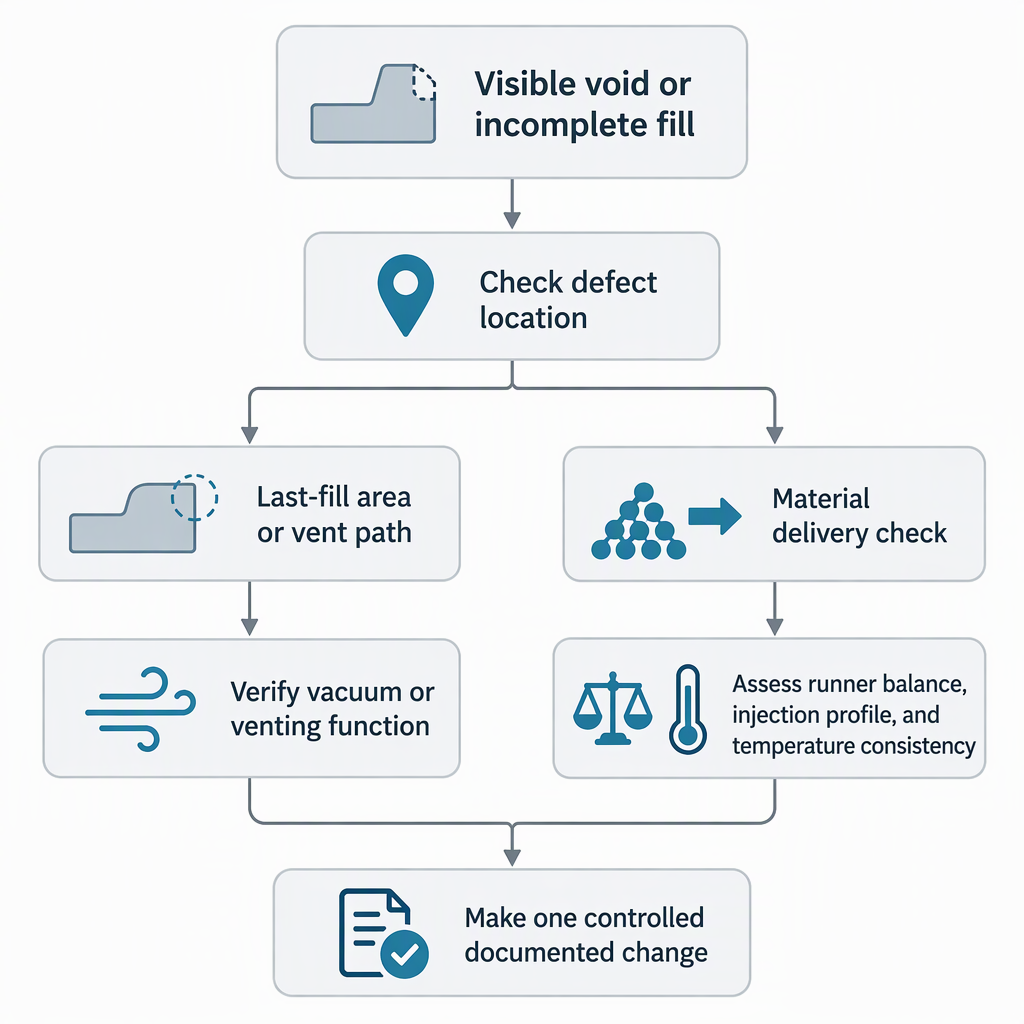
Venting is more likely to be involved when defects repeat near last-fill areas or blocked escape paths, but short shots, bubbles and underfill can also involve vacuum, runner balance, material delivery, injection profile, temperature and mold condition.
| Observed issue | Buyer review question | Why it matters |
|---|---|---|
| Void or bubble repeats in the same last-fill area | Ask how air escape is planned and how vent condition will be checked. | Repeated location can point to a trapped-air path, blocked vent or local flow issue. |
| Incomplete fill appears across multiple cavities | Ask whether runner balance, material feed and injection profile were reviewed before changing the tool. | Short shots can involve more than vent geometry, including delivery and process settings. |
| Defects vary after cleaning, setup or production changes | Ask for a controlled comparison of mold condition, vacuum or venting function and process setup. | Variable defects may come from changing mold or machine conditions rather than a single design feature. |
Avoid treating pressure or speed as the only corrective lever. A higher-pressure fill can still leave air trapped if the escape path is inadequate or if another process variable is creating the defect.
A practical mold-review workflow before changing the tool
Before modifying vent design or changing the injection profile, review the defect location, cavity fill path, vent condition, material delivery, vacuum or venting function, temperature and mold condition in a controlled order.
- Map the defect. Mark where voids, bubbles or incomplete fill occur on the drawing and on sample photos.
- Relate the defect to filling. Identify likely last-fill zones, long flow paths and features that can close off air escape.
- Check mold and vent condition. Confirm whether vents, vacuum paths or parting-line escape routes are clean, open and appropriate for the observed defect.
- Review process variables. Compare material delivery, runner balance, injection profile, temperature and cure-related conditions before approving a tool change.
- Change one factor at a time. Ask the supplier to document what changed and what sample result followed, so the final mold decision is not based on guesswork.
If a physical inspection requires manual access to powered molding equipment, switch off and disconnect the relevant electrical, hydraulic, pneumatic or battery power source before access, follow the model manual’s permitted access procedure and do not bypass guards.
How this applies to silicone consumer-product sourcing
For silicone consumer-product sourcing, venting should be discussed as part of the supplier’s material, mold development, forming, application and quality-file review rather than as a stand-alone mold feature.
| Buyer topic | What to confirm | How it supports venting decisions |
|---|---|---|
| Material selection | Confirm the intended silicone material family and processing route. | LSR behavior and heat-cure processing affect how the cavity fills and how trapped air is managed. |
| Mold development | Share drawings, 3D data, cosmetic faces and expected parting-line constraints. | Vent paths must be reviewed against the actual fill path and defect-sensitive features. |
| Application and packaging | Clarify use environment, handling, appearance requirements and packaging surfaces. | Mitour Silicone’s service scope includes product design, mold development, materials, packaging and silicone product categories, which are relevant discussion areas for OEM/ODM projects. |
| Quality files | Ask what inspection records, sample photos and material documents will accompany samples. | Documentation helps separate a mold-venting defect from a material, handling or application requirement. |
RFQ data to confirm before mold venting decisions
A useful RFQ should give the supplier enough geometry, material, cosmetic, use-case and documentation information to judge whether venting, process setup or part design is the likely risk area.
- 2D drawings and 3D files, including wall thickness, ribs, bosses, lettering and undercut areas.
- Target silicone material, hardness range, color and any known molding route preference.
- Cosmetic priority zones, parting-line limits and surfaces where vent marks are unacceptable.
- Photos or sample notes showing where voids, bubbles or incomplete fill have appeared.
- Expected service discussion areas such as product design, mold development, material selection, packaging and OEM/ODM path.
- Consumer-product documentation topics that are separate from mold filling, such as volatile-compound testing context referenced by the German Federal Institute for Risk Assessment.
Volatile-compound documentation is a product-safety or testing topic, not proof that a mold vent will prevent voids. Keep process-defect review and consumer-product documentation in separate RFQ questions.
Limits of venting: when the cause is not the vent
Venting alone cannot guarantee void-free or fully filled silicone parts because air management interacts with material preparation, delivery, runner balance, vacuum function, injection profile, temperature and mold condition.
Do not treat any universal vent depth, width or land length as correct for every silicone mold. Instead, ask the supplier to justify the proposed vent dimensions for the specific geometry, silicone material, gate location, cosmetic surfaces and tooling constraints.
- If the defect follows a last-fill location, vent path and mold condition deserve close review.
- If defects shift with setup or production conditions, review material delivery, vacuum or venting function, temperature and injection profile.
- If air is introduced before molding, mixing and deaeration practices may also affect final void risk.
- Ask for sample-based documentation of the change made, the observed result and the remaining limitation.
Conclusion
The best buying decision is to review silicone mold venting as one part of a controlled mold, material and process discussion—not as a single guaranteed fix.
Before RFQ or mold approval, send complete geometry, target material, cosmetic requirements, use conditions and documentation expectations. Then ask the supplier to explain how venting, flow path, material handling and inspection records will be checked for your specific silicone part.
Frequently asked questions
These answers help buyers frame practical questions before discussing silicone mold venting with a supplier.
What is silicone mold venting?
It is the planned escape path for air and gases as silicone fills a mold cavity, especially near last-fill areas where trapped air can create bubbles, voids or incomplete fill.
Does venting prevent all voids?
No. Venting helps with trapped-air risk, but voids can also involve material delivery, runner balance, injection profile, vacuum function, temperature and mold condition.
Why does LSR background matter for a venting discussion?
Liquid silicone rubber is a two-part material that is mixed and heat-cured, so the material system and processing route affect how fill behavior and air removal should be reviewed.
What defect information should I send to a supplier?
Send photos, sample labels and drawing markups that show where bubbles, voids or incomplete fill occur, because repeated location helps identify whether a vent path or another process variable is involved.
Can I request exact vent dimensions in the first RFQ?
Ask for the supplier’s proposed venting approach, but do not assume one universal dimension fits every silicone part. Geometry, material, gate location, cosmetic limits and tooling constraints should drive the final design review.
How can Mitour Silicone discuss this during OEM/ODM sourcing?
Mitour Silicone presents custom silicone OEM/ODM services that include product design, mold development, materials, packaging and silicone product categories, so buyers can frame venting as part of the broader product-development discussion.
Is volatile-compound testing the same as mold venting review?
No. Volatile-compound testing is a separate consumer-product documentation topic; it should not be used as evidence that a mold venting design will prevent voids or incomplete fill.


